In case you haven't heard, the
Phoenix Lander successfully landed near the North Pole of Mars on Sunday! Its going to dig through the ice to hopefully find signs of live or at least chemical compounds that suggest life.
Whats really cool is that the MRO (Mars Reconnaissance Orbiter) actually captured an image of the Phoenix Lander parachuting through Mars' atmosphere!!


According to
NASA's website:
NASA's Mars Phoenix Lander can be seen parachuting down to Mars, in this image captured by the High Resolution Imaging Science Experiment (HiRISE) camera on NASA's Mars Reconnaissance Orbiter. This is the first time that a spacecraft has imaged the final descent of another spacecraft onto a planetary body.
From a distance of about 310 kilometers (193 miles) above the surface of the Red Planet, Mars Reconnaissance Orbiter pointed its HiRISE obliquely toward Phoenix shortly after it opened its parachute while descending through the Martian atmosphere. The image reveals an apparent 10-meter-wide (30-foot-wide) parachute fully inflated. The bright pixels below the parachute show a dangling Phoenix. The image faintly detects the chords attaching the backshell and parachute. The surroundings look dark, but correspond to the fully illuminated Martian surface, which is much darker than the parachute and backshell.
Phoenix released its parachute at an altitude of about 12.6 kilometers (7.8 miles) and a velocity of 1.7 times the speed of sound.
The HiRISE acquired this image on May 25, 2008, at 4:36 p.m. Pacific Time (7:36 p.m. Eastern Time). It is a highly oblique view of the Martian surface, 26 degrees above the horizon, or 64 degrees from the normal straight-down imaging of Mars Reconnaissance Orbiter. The image has a scale of 0.76 meters per pixel.
NASA's Jet Propulsion Laboratory, a division of the California Institute of Technology in Pasadena, manages the Mars Reconnaissance Orbiter for NASA's Science Mission Directorate, Washington. Lockheed Martin Space Systems, Denver, is the prime contractor for the project and built the spacecraft. The High Resolution Imaging Science Experiment is operated by the University of Arizona, Tucson, and the instrument was built by Ball Aerospace & Technologies Corp., Boulder, Colo.
NASA/JPL-Caltech/University of Arizona
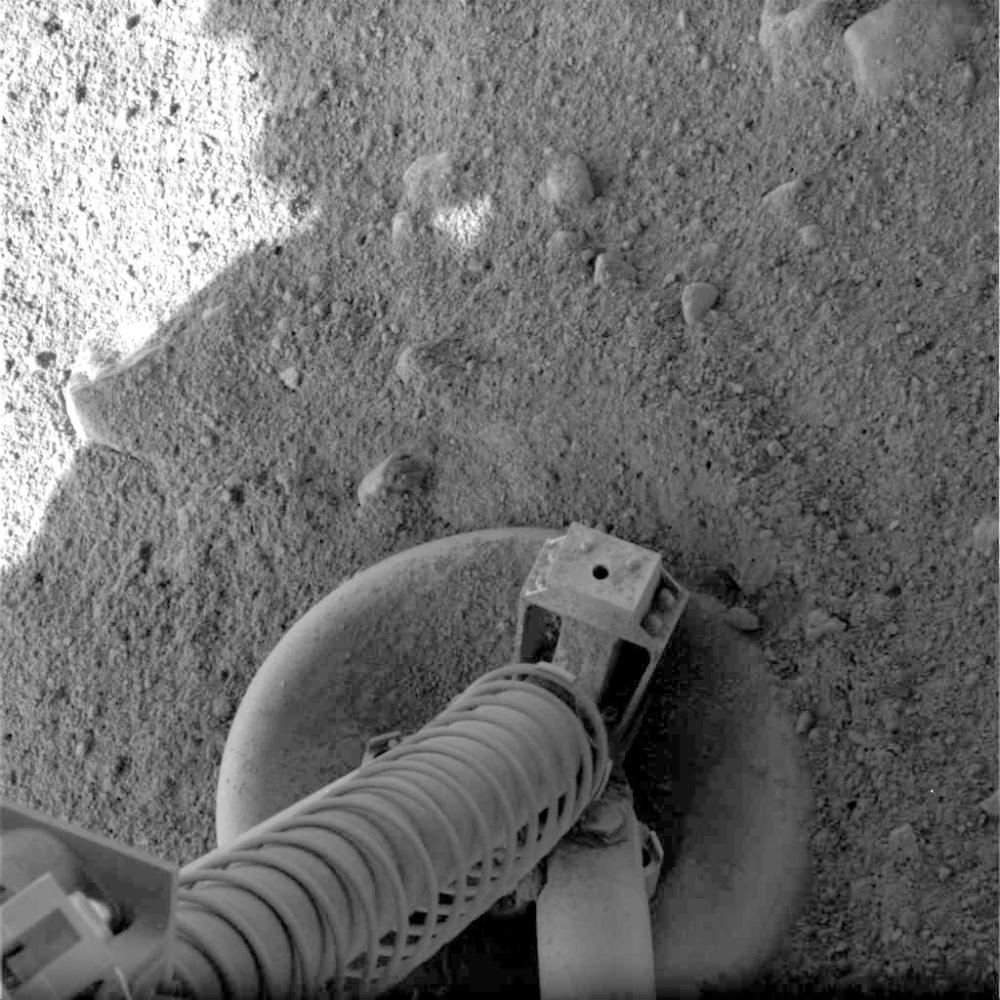
I love that one of the first things a lander does upon landing is to take a picture of one of its feet on the surface! I think its so adorable! (And yes, I do have an abnormal attachment to inanimate objects!)
 "Oooh, look!! It's my foot!! Check it out! I'm on Mars!"
After that, it takes pictures of the landscape . . . enjoy!